Nov 14, 2026
Kamini
Ramani
Kamini Ramani is the author of the best-seller Lotus Leadership book – a collection of wisdom from 33 women who have built meaningful careers. Previously she was a CMO at Mayfield Fund. She is also a Founding Circle Member of Neythri.
One Line Life Lessons from Kamini



Episode Highlights
- 00:16-00:27: Kamini Ramani introduces herself as a former and forever Bombayite, who was born and raised in Bombay and moved to the U.S. about 40 years ago.
- 00:27-00:39: Kamini Ramani describes her education and career, which include degrees in English literature and communications from Yale and Stanford and 40 years working in Silicon Valley.
- 01:04-02:20: Kamini Ramani explains her identity as a storyteller, which stems from her early love of reading, writing, and listening to stories, and her work translating complex technology into plain English.
- 02:20-02:37: Kamini Ramani draws a parallel between storytelling and the current age of AI, emphasizing that people want to hear stories shared by humans.
- 03:01-04:36: Kamini Ramani explains why she wrote Lotus Leadership, which stems from her wish to highlight the many Indian-American women leaders whose stories are less known, and her hope that the next generation gets a playbook to rise without burning out.
- 05:04-05:38: Kamini Ramani describes the either-or tyranny that women leaders often face, emphasizing that they can be both feminine and masculine, aggressive and empathetic, or assertive and compassionate.
- 06:19-07:25: Kamini Ramani shares the opportunity she is most excited about, which stems from writing her book at age 60 and the cultural respect for age as wisdom rather than irrelevance.
- 08:18-10:08: Kamini Ramani recalls a disappointing experience in 1995, when she worked closely with Steve Jobs and did not secure a communications role at Pixar, which taught her the importance of advocating for herself.
- 11:19-12:31: Kamini Ramani describes her greatest success as a partnership with her husband, which she sees as built on shared values and mutual pride in each other’s achievements.
- 13:08-13:50: Kamini Ramani explains that she enjoys forest bathing in Golden Gate Park, which she sees as a source of quiet and wisdom.
- 14:09-15:02: Kamini Ramani recommends Rebecca by Daphne du Maurier and the podcast Hidden Wisdom as sources of inspiration.
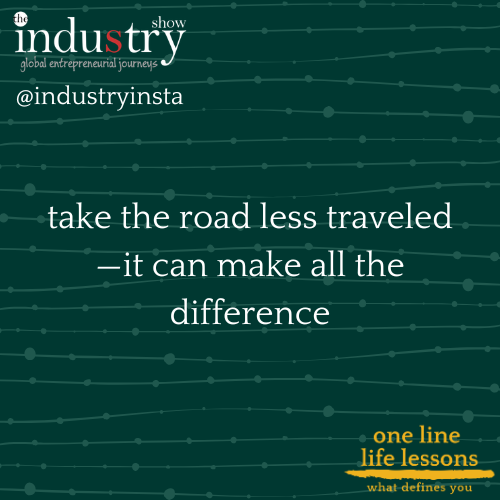
- 15:16-16:48: Kamini Ramani shares two life lessons, drawing on Robert Frost’s road less traveled and Walt Whitman’s idea that she contains multitudes, which gives her permission to hold many roles at once.
Show Transcript
Transcript - Full Episode
00:00:00 – 00:00:07 Nitin Bajaj
Welcome to The INDUStry Show. I’m your host, Nitin Bajaj, and joining me today is Kamini Ramani. Kamini, welcome on the show.
00:00:08 – 00:00:10 Kamini Ramani
Thank you. So great to be on it.
00:00:11 – 00:00:14 Nitin Bajaj
Great to have you here. Let’s start with who is Kamini?
00:00:16 – 00:00:38 Kamini Ramani
So Kamini is a former and forever Bombayite, born and raised there. Came to the U.S. about 40-some years ago, and now I live in San Francisco. And in between, I picked up a couple of degrees in English literature and communications from Yale and Stanford, and I worked for 40 years in Silicon Valley.
00:00:39 – 00:01:04 Nitin Bajaj
Amazing. We share deep roots, Bombay forever. Love that. And I always like to know why people do what they do. And living in the Valley, coming from Bombay, you could have done anything you wanted. Why did you choose to do what you have done, and also tell us the story behind Lotus Leadership?
00:01:04 – 00:01:10 Kamini Ramani
Sure. You know that saying Bombay is a city Mumbai is a city, Bombay is an emotion.
00:01:11 – 00:01:11 Nitin Bajaj
Yes.
00:01:11 – 00:01:25 Kamini Ramani
I completely relate to that. There’s just something very special about that place. I am a storyteller, first and last. When I discovered that superpower relatively early in life, I love to read, I love to write, I love to listen to stories.
00:01:26 – 00:01:41 Kamini Ramani
And as growing up in India, you just look out of your window and there’s a story. So when I came to Silicon Valley in 1984 was when I first moved to Stanford to get my master’s degree there, and I graduated two years later.
00:01:41 – 00:02:02 Kamini Ramani
Silicon Valley was a very technical place where there were all these innovations, but the founders didn’t know how to explain that in plain English to consumers. So people like me, who could do that, who took the rigor to understand the technology but then helped them translate their benefits into plain English, were very much in demand.
00:02:02 – 00:02:19 Kamini Ramani
So I’ve been a storyteller since, and now in the age of AI, I think storytelling with a soul has come back even stronger. Because we’re all tired of AI slop, and we want actually to hear from people, humans, who are sharing stories.
00:02:20 – 00:02:37 Nitin Bajaj
So true. People talk about the negative impacts of AI in terms of jobs or in terms of how businesses are having to reinvent. To me, the biggest challenge and the biggest opportunity there is the human connection.
00:02:37 – 00:02:44 Nitin Bajaj
And I’m so glad that you saw that and you’re already ahead of the curve in defining that. Obviously, you live in the Valley.
00:02:45 – 00:02:55 Nitin Bajaj
But tell us more about Lotus Leadership and what’s your vision with it. It’s just getting in the hands of people. There’s a lot of excitement around it.
00:02:55 – 00:03:01 Nitin Bajaj
I know you’re planning a whole tour in India. Give us the behind the scenes.
00:03:01 – 00:03:16 Kamini Ramani
Sure, sure. So I wrote this book to do two things. One, I felt that the Indian-American success narrative focused a lot on the men and not enough on the women. I think your show is different. You seem to have a lot of amazing women as guests.
00:03:17 – 00:03:37 Kamini Ramani
But in general, when you think about Indian-American success, really it’s the male leaders who come to mind, Satya Nadella of Microsoft, Sundar Pichai of Google, who all absolutely need to be celebrated. But I found that there were tons of powerful and wise women in my network whose stories I thought also needed to be told.
00:03:37 – 00:04:05 Kamini Ramani
Now, one of the women in my book is a household name, and that’s Indra Nooyi. But other than her, there are many women you may not have heard of. The COO of Zoom who got us through the pandemic is an Indian woman. The board member at Uber, who is the CEO of Flex, is an Indian woman. An amazing, award-winning astrophysicist at Yale who’s come up with a whole new theory on black holes is an Indian woman. And the list goes on.
00:04:06 – 00:04:31 Kamini Ramani
So when I wrote the book, I was just wanting to set the record straight. And the second reason I wrote the book, I think you and I chatted about this briefly, we have two daughters who are 26 and 32. And I wanted to see if the women I interviewed for the book would share vulnerable stories and wisdom so that the next generation gets a playbook to rise without burning out.
00:04:31 – 00:04:38 Kamini Ramani
And I’m very happy to say that I think the book has done that. It’s a USA Today bestseller.
00:04:38 – 00:05:03 Nitin Bajaj
I love that. And knowing you, I wouldn’t have expected anything less. And I know you had to really pick and choose the 30 stories that you brought to life, at least in this version. Now, amongst the many things that you’ve experienced and continue to face, what’s the one big challenge you face and would like to call out?
00:05:04 – 00:05:22 Kamini Ramani
All leaders, but especially women leaders, get stuck into this either-or tyranny. You can either lead in a feminine way or a masculine way. You can be aggressive or empathetic. You can be assertive or compassionate. You can be mission-driven or really analytical.
00:05:23 – 00:05:37 Kamini Ramani
And woman after woman in this book I interviewed said, “We reject that tyranny. We can be both and more.” So I think if you can internalize that you get to be more than one thing at the same time, that’s a very freeing way to lead.
00:05:38 – 00:05:49 Nitin Bajaj
You know, that deeply resonates with me, one, as a parent of two daughters, but also as someone as we are building the American South Asian network.
00:05:50 – 00:06:01 Nitin Bajaj
The biggest challenge we wanted to address was this duality of having to pick between, “Am I South Asian or am I American,” when you are and can be both.
00:06:02 – 00:06:10 Nitin Bajaj
So kudos to you on picking on that and sharing that and narrating that through so many different folks and their stories.
00:06:11 – 00:06:15 Nitin Bajaj
Now, on the flip side of challenges come opportunities.
00:06:15 – 00:06:19 Nitin Bajaj
What’s the one you’re most excited about?
00:06:19 – 00:06:37 Kamini Ramani
You’re never too old to fulfill your dreams. That’s what this author journey has shown me. I got the idea for the book three years ago on my 60th birthday. I was on holiday in Mexico with my sister, and I was saying to her, “There are all these amazing Indian women. How come there’s no book that collects their wisdom?”
00:06:37 – 00:06:48 Kamini Ramani
And so she said, “It’s time to write your book.” And so who would have thought that at 60 I would embark on this as a project? So I quickly hung up my work boots. I worked really hard on this.
00:06:48 – 00:07:07 Kamini Ramani
I was lucky to get HarperCollins US as a publisher and all the support along the way that an author needs to get a book into the hands of readers. And so that’s one of the opportunities. I think Indian culture, but not only Indian culture, reveres age as wisdom rather than as irrelevance.
00:07:07 – 00:07:24 Kamini Ramani
So somehow, maybe we don’t feel as much of a pressure on you have an expiry date, and unless you achieve your dream by 30 or get to the corner office by 40 or whatever your dream is, you’re never going to make it. So that’s been one of the really joyful discoveries of this journey for me.
00:07:25 – 00:07:46 Nitin Bajaj
Beautifully said. And again, we, I think, in many ways lack role models outside of the typical definitions of success in our community. And I’m so glad that you’re setting the stage and being that role model that many of us, including our daughters or children, need to have.
00:07:46 – 00:07:51 Nitin Bajaj
So really happy for you and for everything you’re bringing to life.
00:07:51 – 00:08:14 Nitin Bajaj
Now, as we look forward, I love to pause, reflect, take this moment to invite you to share two moments from your life, one where things did not work out as you had expected. There was disappointment, failure, lessons, and another where things exceeded your expectations and became a success beyond your imagination.
00:08:15 – 00:08:24 Kamini Ramani
So I’ll start with the disappointment. It was 1995. I was working really closely with Steve Jobs.
00:08:24 – 00:08:38 Kamini Ramani
He actually had been fired from Apple about a decade earlier. He was running Next, and he had to let go of the hardware because it was too expensive, and he was focusing just on the software. So candidly, he was in exile.
00:08:38 – 00:08:51 Kamini Ramani
The industry had written him off, but he’s a genius, and you never underestimate a genius. So he kept his self-belief going and his conviction going. In addition to leading Next at the time, he had invested in Pixar.
00:08:52 – 00:08:52 Nitin Bajaj
Yep.
00:08:52 – 00:09:03 Kamini Ramani
And that was the year that Toy Story was debuting and Pixar was going public. And he owned 80% of Pixar and became a billionaire through that IPO, made much more money than he did in his time at Apple.
00:09:04 – 00:09:26 Kamini Ramani
I was working very closely with him, and he wanted to have a communications advisor who would help him for both his companies. And the Pixar folks were creative geniuses. They were not interested in some tech PR person, and even if it was a especially, I think, if it was an advisor of Steve to show up there. And so they really didn’t want that.
00:09:26 – 00:09:51 Kamini Ramani
And I didn’t quite know how to sell myself in there because I didn’t have entertainment industry experience. And we went back and forth a little bit, and then he said to me, “You know what? I don’t think you have hotspot,” which was a word I’d never heard before, which is kind of like aucat in Hindi or moxi. That kind of audacity, I think, is the best way to describe it. It’s a Yiddish word, hotspot is a Yiddish word.
00:09:52 – 00:10:16 Kamini Ramani
And maybe I didn’t. I was early in my career, and I didn’t know how to go sell myself to a team that didn’t value my skills. And so as a result, that joint appointment didn’t materialize, and I went on to do other great things. But it was a real lesson in believing in yourself and learning how to advocate for yourself in a way that you get to the outcome you want.
00:10:18 – 00:10:38 Nitin Bajaj
Thank you for sharing that and so openly. And I’m sure when you were going through that, the feelings, the emotions, just all of that must have been overwhelming. But it’s kudos to you for remembering that 30-some years later and sharing that for the greater good. I really appreciate that.
00:10:39 – 00:11:01 Kamini Ramani
And it’s nothing compared to the vulnerable stories the women in my book have shared. They navigated all kinds of challenges to get to the top, and they were really clear that they wanted to be honest about the journey so that the next generation understands life will throw you curveballs. So my story even pales in comparison to some of the other searing stories in the book.
00:11:01 – 00:11:18 Nitin Bajaj
I do love your humility. You used a few words. You were lucky. You’ve been fortunate, but there’s a lot of hard work that went into it, and I want to acknowledge that. Now, please share your success. I would love for you to brag a little bit.
00:11:19 – 00:11:29 Kamini Ramani
It’s going to be surprising what I brag about. I’ve been, again, fortunate to build a wonderful partnership with my husband over 35 years.
00:11:29 – 00:11:46 Kamini Ramani
We met in 1986 while I was at Stanford. He was in the business school, and I was in the graduate school doing my master’s in communications. We came from very different backgrounds. I’m, as I said, I’m Indian, raised in India, Bombay, and so on.
00:11:47 – 00:12:06 Kamini Ramani
He was raised in Europe and Pakistan, so he’s half and half. His mother’s Dutch, and his father was Pakistani, and he grew up in Vienna, Austria. So you would think there’s not much in common, and especially, let’s be honest, he was the other, the Indian, Pakistani, Hindu, Muslim thing.
00:12:06 – 00:12:19 Kamini Ramani
But we found each other. We had a lot in common. We actually, we discovered, and just we had that spark. So we’ve really built a very equitable arrangement.
00:12:19 – 00:12:34 Kamini Ramani
And one of the sections in my book talks about that is your life partner, your cheerleader. You want that person to be so proud of your success more than anyone else. And we do that for each other. And I think our daughters have seen that, and we’ve modeled that behavior.
00:12:35 – 00:12:46 Kamini Ramani
So to me, the greatest success in my life is to have found someone who may not have come from the same background, but who shares my values.
00:12:47 – 00:13:06 Nitin Bajaj
Love that. We don’t hear much and often enough, as we should, about that. That’s, I think, the most important partnership, the most important decision one can make. And really happy for both of you. Now, switching gears, what do you do for fun?
00:13:08 – 00:13:18 Kamini Ramani
I love forest bathing. You know that concept, the Japanese concept where you go among the trees and you’re quiet and meditative, and you just let nature heal you.
00:13:18 – 00:13:33 Kamini Ramani
I am lucky. We live up the street from Golden Gate Park in San Francisco, and they have beautiful trees there, redwoods, but also all kinds of other trees. And so even this morning, before coming to talk to you, it’s a gorgeous day in San Francisco. The sun is out.
00:13:33 – 00:13:49 Kamini Ramani
So I do that every day, two times a day. In the morning, I have a long meditative walk, and then in the late afternoon, I have a shorter one. And just the kind of wisdom I get from just being in nature and that quiet is just so precious.
00:13:50 – 00:13:59 Nitin Bajaj
Love that. Is there a book or a podcast that’s a favorite and you want to share with the audience? Of course, in addition to Lotus Leadership.
00:13:59 – 00:14:14 Kamini Ramani
I’m not going to say my own book. I grew up reading a lot of fiction, and I still think one of the books I read in my teens endures. And the reason I know that is our daughters have read it, and they found something magical in it as well.
00:14:14 – 00:14:28 Kamini Ramani
It’s called Rebecca by Daphne du Maurier. She wrote it when she was relatively young, and it’s got a beautiful, there’s beautiful language, there’s a little bit of a mystery in the plot, and I think that’s one that’s remained a perennial favorite.
00:14:29 – 00:14:44 Kamini Ramani
And then the other one is when you, when it came to podcasts, I’ve started listening to one that’s relatively new. I think they only have three or four episodes out, and it’s called Hidden Wisdom. And it’s done by two podcast hosts.
00:14:44 – 00:14:57 Kamini Ramani
Indra Nooyi was the opening guest. The latest guest this week was Kim Scott, who’s written a book called Radical Candor, who gave me advance praise for my own book. And they’ve had other leaders in between.
00:14:57 – 00:15:04 Kamini Ramani
And I do really, they’re really trying to unpack this concept of wisdom and where do you get wisdom from. So that’s been resonating for me.
00:15:05 – 00:15:16 Nitin Bajaj
Amazing. Thanks for sharing both of those. Now, on to my favorite part of the show. We call this the one-line life lessons. Kamini, I would love to hear your life lessons.
00:15:16 – 00:15:38 Kamini Ramani
So I have two that I’d like to share. One is a verse from Robert Frost. The poem is called The Road Not Traveled, The Road Less Traveled, I think it’s called. And the final lines are, “Two roads diverged in a wood, and I took the one less traveled by, and that’s made all the difference.”
00:15:39 – 00:16:02 Kamini Ramani
And all along my journey, I’ve made some zigzags and some untraditional choices. When I got to Yale University, I was doing a master’s in English literature. I could have continued on to a PhD, but I decided I didn’t want to do that because it felt like I would end up in academia into the ivory tower, and I didn’t want to do that. And honestly, it was freezing cold in New Haven, and I didn’t want to be there for another winter.
00:16:02 – 00:16:18 Kamini Ramani
So I made a, took a risk, made a decision, came across the country, and did a second master’s in communications, which threw me more into business. And all along the way, there’s been all kinds of unconventional decisions I’ve made. And so I think that resonates for me.
00:16:18 – 00:16:47 Kamini Ramani
The other one is Walt Whitman, who’s a poet I like, who says, “I am large, I contain multitudes.” And by that, I just think it gives you permission to keep your duality or your multidimensionality. We are all these things at the same time. You’re Indian and American. You’re a mother, a wife, a daughter, a sister, a friend, a caregiver, and the list goes on.
00:16:48 – 00:16:51 Kamini Ramani
So that is another one that really speaks to me.
00:16:52 – 00:17:14 Nitin Bajaj
Love that. Kamini, thank you for sharing those. And also, thank you for making the time to share your journey, your story, your life lessons. I’m really excited to get this book in more people’s hands and wishing you all the luck and energy for your whirlwind tour that’s coming up in India.
00:17:15 – 00:17:27 Kamini Ramani
I thank you so much. And anybody can find me at lotusleaders.org. So if folks get the book, they have any questions, they want to engage, that’s where they should find me. Thank you so much, Nitin.
Subscribe!