Jan 17, 2026
Lakshmi
Pratury
Lakshmi Pratury is the Founder & CEO of INK – a platform orchestrating transformative conversations inspiring millions and nurturing young innovators and women. Previously she held leadership positions at Intel, AIF, TED.
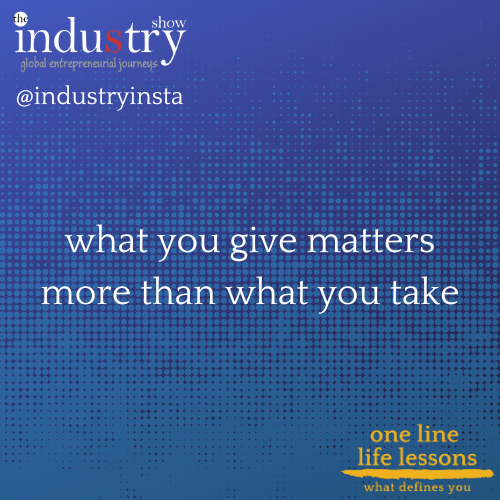
One Line Life Lessons from Lakshmi


Episode Highlights
- 00:18-01:10: Lakshmi Pratury introduces herself as “The Chauffeur” a connector who is attentive to people and enjoys facilitating connections.
- 01:48-02:54: Lakshmi Pratury draws a parallel between being a parent and a conduit, emphasizing the pride in others’ success and the importance of being a supportive presence without needing credit.
- 03:17-05:51: Lakshmi Pratury explains the “why” behind INK, which stems from her childhood experience of feeling alone when doing something different and the realization of the need for people to support each other.
- 06:36-11:29: Lakshmi Pratury discusses the 15-year journey of INK, focusing on giving Indian stories a global platform and empowering individuals to tell their own stories.
- 11:30-14:39: Lakshmi Pratury highlights the ripple effect of INK, leading to hundreds of TEDx events and a shift in how stories are told, emphasizing pride and dignity in individual narratives.
- 15:00-16:29: Lakshmi Pratury stresses the importance of starting big and having financial support for ambitious ventures, contrasting her entrepreneurial journey with her earlier life experiences.
- 16:45-21:23: Lakshmi Pratury discusses the current inflection point in technology with AI, emphasizing the urgent need for inclusive AI development and access to prevent further inequity.
- 21:39-21:55: Lakshmi Pratury frames the biggest challenge and opportunity as making AI inclusive and encourages sharing resources to achieve this.
- 22:32-22:57: Speaker 3 shares a motto: “build fast, become obsolete,” encouraging continuous reinvention and moving on when others can do it better.
- 23:14-25:18: Lakshmi Pratury describes her escapes: spending time with people, long solitary walks, and staying with friends when traveling instead of hotels.
- 25:18-26:41: Speaker 3 emphasizes the importance of knowing one’s core group of people and the value of internal reflection and honest self-assessment.
- 26:41-27:16: Lakshmi Pratury reflects on her fortune in being born into a loving family and having her basic needs met, considering doing what she loves a luxury.
- 27:52-29:05: Lakshmi Pratury shares her principle of using and sharing resources, including living in others’ homes and inviting friends to use her space, promoting the idea of sharing capacity.
- 29:17-33:48: Lakshmi Pratury shares her life lessons: failure is optional, sharing brings joy, children teach us about our parents, life is a marathon, and legacy is about what you leave behind, not what you take.
- 34:00-35:00: Lakshmi Pratury humorously explains her strategy of wearing friends’ saris and leaving them behind, promoting borrowing and sharing as a way to keep the economy going.
- 35:33-36:14: Lakshmi Pratury reflects on the misconception of waiting for external validation and the reality of self-creation, humorously expressing a wish for a large sum of money to fund future endeavors.
Show Transcript
Transcript - Full Episode
00:00:00 – 00:00:08 Nitin Bajaj
Hey everyone, welcome to the Industry Show. I’m your host, Nitin Bajaj, and joining me today is Lakshmi Pratury. Lakshmi, welcome on the show.
00:00:08 – 00:00:09 Lakshmi Pratury
Thank you.
00:00:10 – 00:00:11 Nitin Bajaj
Great to have you here.
00:00:11 – 00:00:15 Lakshmi Pratury
Yes. After following you for so long, it’s good to actually have a conversation.
00:00:16 – 00:00:21 Nitin Bajaj
Thank you for saying that. Let’s start with a big question. Who is Lakshmi?
00:00:22 – 00:01:18 Lakshmi Pratury
Oh, wow. If I have to give myself a title, I think I have to say, “The Chauffeur ” and it comes from a movie as an author in the United States that has been the most important part. I’m the Chauffeur, I open the door, the hero gets out with the car, and the movie would not have started if I did not open the door. I have the most important job. It always stayed with me. Platform got so many people. So many become popular because they spoke at it or somebody gets connected to it. More often than not, they forget about the success out there doesn’t know who are people. So I think like I probably wear the Chief Chauffeur badge as I have a very great sparring talent and I’m very attentive to people, and I just enjoy doing that.
00:01:19 – 00:01:25 Nitin Bajaj
Love that. And in many ways, I’m following your footsteps in being that conduit and becoming…
00:01:25 – 00:01:40 Lakshmi Pratury
And it takes a lot of us, I think, for the world to move on, for things to happen. We need a lot more connectors who are okay if people forget. Otherwise, if everything becomes a transaction, it’s very difficult to be just open to connecting for no reason.
00:01:41 – 00:01:48 Nitin Bajaj
True. And I’ve come to believe and say that I take all the pride. I don’t take the credit, but I can take all the pride.
00:01:48 – 00:02:02 Lakshmi Pratury
It’s like being a parent,right? When your kids do really well, it’s their joy. You have nothing to do with it. And you are proud. Hopefully, they’ll remember you and come see you once in a while. But beyond that, you’re just a conduit.
00:02:03 – 00:02:17 Lakshmi Pratury
And I think it’s very philosophical. It sounds all very easy to say it. Ten years ago, I don’t think I would have felt this way. I would have felt a lot better. And I did that for them. They didn’t recognize me or I was very, very upset.
00:02:18 – 00:02:32 Lakshmi Pratury
But I think it’s ages ago that you actually see what happens out there. And it always comes around to you or your family somehow in the bigger picture that you stop worrying about the shorter picture.
00:02:33 – 00:02:36 Nitin Bajaj
Yeah. A bigger role you play in the ecosystem. And things come around.
00:02:37 – 00:02:59 Lakshmi Pratury
Yeah. They just come over. I’ve never had to worry about, “Oh my God, how will this happen?” And every time I have that shit on my stomach that scares me, “Oh my God, how will this happen?” Somehow somebody comes through. So you just see, you just don’t worry about the outcome. Just keep doing your stuff and the universe will go on.
00:03:00 – 00:03:16 Nitin Bajaj
Let’s talk about Ink. I’m always curious to know why people start something, how people end up doing the things they do. So tell us about the why. And then through that, the impact you and the team have been able to create through this journey.
00:03:17 – 00:03:34 Lakshmi Pratury
Being sats for innovation and knowledge. But really, to me, it’s been about writing our future together. And I think most of our passions, what we do professionally, whatever we choose to do professionally comes from something that’s happened long time ago that you just didn’t know.
00:03:34 – 00:04:02 Lakshmi Pratury
So it’s much after I started Ink I started realizing that I grew up at a time in India where people were asked too many questions. Luckily, I grew up in a household where my father never remembered if we were boys or girls. It was always like, “Do whatever you can.” And face the world. So I’ve even got an amazing support system at home and my close friends to whom I could do no wrong.
00:04:02 – 00:04:26 Lakshmi Pratury
But in a wider sense, I was felt very alone. And especially when you’re doing something different, something that doesn’t fit in, you feel alone. No matter how much you’re accomplishment maybe. And I feel that when somebody’s doing something new, I recognize that confidence. And that knowing is actually good. It gives you energy to keep moving forward.
00:04:27 – 00:04:51 Lakshmi Pratury
But it is good. It’s the way to have someone that says, “I get you.” That’s all you get. Someone who stands next to you and says, “I’m here for you.” You know, my father did that for me. My sister did it for me. My best friend did it for me. At every point in life, nothing was easy. And I felt I had these amazing people who supported me.
00:04:51 – 00:05:23 Lakshmi Pratury
And I guess somewhere I knew that I would always get the background that those who do support just talk to me. Even if you have accomplished in the traditional sense of the word, there is a side of you that you don’t show. And that’s what I’m interested in. It would be CEO of a… And that’s why to me, when you’re in a second-round gun talks and work on what would be great for this giant, it’s so much more interesting than for the company’s dream, which I can read.
00:05:25 – 00:05:50 Lakshmi Pratury
So to me, I’m always interested in seeing the mirror of the person to see who I am. And that is so beautiful. And because I understand a lot of times why we have to be that bigger, but it’s a long picture. And I think that’s why for me, it’s always about how do I create something for people. So people can be there for each other. So we don’t feed on each other.
00:05:50 – 00:06:10 Lakshmi Pratury
Yes. Yes, absolutely. And I think there are many of us around, but we are not connecting with each other. I always say the bad in the world, someone finds each other very well. But the good in the world always works inside us. So if the good in the world can come together, it’s beautiful.
00:06:12 – 00:06:35 Nitin Bajaj
I love that. And this is something we’ll talk about as we discuss. But coming back to the why obviously has over the span of years led to some impact that you’ve created in the community. Talk to us about that in terms of the lives that have been impacted, the geographies that you’ve touched upon, and the stories you’ve brought to life through this.
00:06:36 – 00:06:53 Lakshmi Pratury
We’ve been around for 15 years now. So I feel now we can talk about the impact that we had. So when we first started the journey, I just wanted the Indian stories to show up on a global stage where Indians are talking as equals.
00:06:53 – 00:07:21 Lakshmi Pratury
I come from a generation where all the information was in the West. And we always looked to the West to give us answers, approval to make sure we are doing somethingright. I have benefited from going to the West and studying there, having access to that information and learning that way of life. And I have learned how to deal with the world as an equal. Whether I’m a only short brown woman in a sea of…
00:07:21 – 00:07:22 Nitin Bajaj
Which you’re doing a lot of.
00:07:23 – 00:07:56 Lakshmi Pratury
Yeah, tall white men, or whether it is a room full of amazingly beautiful people when you work in Hollywood or whatever. I have learned how to stand in my own two feet and at my own height. And I think that takes years of practice and it takes years of learning, watching others and learning. So how do you integrate that into a culture that has been for over 200 years being emotionally kept down?
00:07:57 – 00:07:58 Nitin Bajaj
Subdued in many ways.
00:07:58 – 00:08:30 Lakshmi Pratury
Yeah. And it’s, I think, emotional subdual, subduation, whatever the word is, tougher than physical abuse. And so I feel that over the British rule, while we kept our culture intact, etc., somewhere there was a loss of courage, loss of the thing that Tagore writes about, freedom of mind. And somewhere we looked to the West for that approval.
00:08:30 – 00:08:49 Lakshmi Pratury
And I felt the new generation that’s coming has no such baggage. They’re born in a free India. They’re born in post-91 India, which is truly when we got our economic freedom. So the way they look at the world is very different. And especially the digital generation, they have access to everything.
00:08:49 – 00:09:18 Lakshmi Pratury
So by the time it’s my son’s generation, it’s equal. Like a kid here or a kid there has access to the same information. But their voices are not heard because our generation is still controlling everything, who’s still enamored by somewhere outside. So we need to seek approval outside before we are recognized in India, whereas there are amazing voices in India that are doing great stuff.
00:09:19 – 00:09:43 Lakshmi Pratury
So I really felt that we need to bring something in that can give that platform. And of course, I looked to the West. Of course, I looked to TED because that’s where I was living. I loved the way they would bring unknown voices, etc. So I felt if we brought that to India and learned from them how to do it, we can launch something from India that can go global.
00:09:44 – 00:10:05 Lakshmi Pratury
And luckily, I had amazing people, Chris and Kenny and Joe. I mean, like the TED team was just a dream team to work with. And we all came to India, we hosted TED India. We learned how to do it and how to train people to tell their story in 10 minutes, in 15 minutes, how to edit it, how to post it.
00:10:06 – 00:10:27 Lakshmi Pratury
In the post-YouTube world, it’s very different. But if you’re thinking 2008, 2009, we just didn’t know how to do it. And so we learned all that and to bring that to India and open up literally hundreds of TEDxs, etc. And it started an evolution of the importance of telling your story in your voice.
00:10:28 – 00:10:59 Lakshmi Pratury
Till then, I felt our stories were told by somebody else, by journalists, by journalists from outside who have no understanding of who we are. So I felt the person who’s doing the work should tell a story instead of it being reported. But that person, first of all, thinks what they’re doing is not great. And secondly, they don’t know how to talk about it. Even if they know these two, there’s no platform that will be because the media is only interested in the rich people and the well-known.
00:10:59 – 00:11:01 Nitin Bajaj
Or the sensational stories.
00:11:01 – 00:11:30 Lakshmi Pratury
Yeah. Who cares about the weaver,right? We only care about the person who’s selling it. So I always felt we needed to give voices to them in a way that it is open. And one of the quotes I always say that made me start this is that unless the lions start telling their stories, the stories will always be of the hunter. So that’s an African problem. And I really felt the people who are doing the work should tell the story. So that’s how it started.
00:11:30 – 00:12:09 Lakshmi Pratury
So the impact, again, as I said, whatever you do, it has a ripple effect. So you can’t take ownership of it, but you can say I was there when we started it. So if you see today, there are more than 500 TEDxs. There’s more than a dozen talk stories. Beautiful in which stories are coming out. From a time of 2009 when we went, there were hardly any stories of, say, Vicky Roy talking about it or Arunachala Morgana and so many names. I can go on and on. Nobody was listening to their stories to now.
00:12:09 – 00:12:43 Lakshmi Pratury
Literally, there are hundreds of thousands of stories out there at many platforms. In some ways, many platforms have done much better than Ink in terms of how they’ve been able to take advantage of the business side of it. But I think that further saying in Telugu that says that “Putroth Sak on the country, Putroth Jan Minshin of Urkadu.” Happiness for a father or a parent is not when a child is born, but when the child becomes better than this, that’s when there is.
00:12:43 – 00:13:39 Lakshmi Pratury
So for us, like when I look at in 2009 when we brought TED to India, 2010 when we launched Ink, when we told the first stories and raised literally millions of dollars for people who told the stories to where we are today, it’s really beautiful to see how comfortable so many people are in telling their stories, how much time they put into creating the talk, how much time they put into making sure they do a beautiful three-minute talk, etc. Like Vicky Roy on Urkadu, he’s a guy who grew up in the streets and now he’s one of the best photographers. So we took him on a road trip across the US and he would say, “Ma’am, whenever you wake me up, even in the middle of the night, I’ll say 3, 9, or 12.” You know? “Want a three-minute talk? Nine-minute talk? Whatever. I’ll just leave my story in the last 20 minutes.” So it’s to get people to, first of all, see their story themselves and tell it.
00:13:39 – 00:14:21 Lakshmi Pratury
And then impact-wise, from Paramount, the skies pink to Srikant to Malaysia, there are so many movies that came out. And again, it is a process you start and have no ownership of where it goes. But it makes me really proud to say there was a group of us that started it with total blind belief. People have a different heard of TED. They thought it was talked about a guy called TED when we first went to India. And then when we started Ink, people would be like, “Why should I give money? What does it mean? How many products can I sell?” I’m like, “No, you can’t sell.” So thought leadership takes a long time to develop.
00:14:21 – 00:14:43 Lakshmi Pratury
So I think 15 years later, I feel that we have accomplished that pride and that dignity of the story and to listen to something without a bias toward accent or language or social strata. And I think that’s the thing that makes me feel very happy.
00:14:43 – 00:15:00 Nitin Bajaj
Fascinating. Congratulations again. It’s what you have about there stands as no words to really describe, but you did a good job of saying how it has impacted an entire generation, an entire country, and has empowered a billion people to know what a story is and what it stands for.
00:15:00 – 00:15:38 Lakshmi Pratury
I think it’s important to keep saying that because I think otherwise we would have been in a long journey. And if my partner Rano did come and say, “Okay, I put the first check, I put the first check.” It’s not that your money is not enough, but unless 20 others come together. And I must say, to start anything big, you need to start big. I do not believe in the linear growth. You have to have exponential growth. For me, India. So I do want to emphasize to do anything big, you need financial support. And you need your own time.
00:15:38 – 00:16:04 Lakshmi Pratury
If I didn’t work, earn, save, I couldn’t have taken a 10-year journey with that kind of risk. Despite all the money that comes in, you have to put out your own resources. You know this better than anyone else. Any entrepreneur knows this. And especially when you take on something like media storytelling, it’s not like a tech product that people are willing to buy. It’s a much more arduous journey.
00:16:05 – 00:16:31 Lakshmi Pratury
I always joke with my friends and my life went in reverse. In my 20s and 30s, I did the whole private planes and fancy hotels and all that stuff. And I became an entrepreneur in my 50s. Then it’s, “Huh, should I really go business class? If I go economy, maybe two of us can travel.” So it’s like I feel that’s why I stay very young because I’m living like a 20-year-old, not a 20-year-old. So I think everything has a benefit.
00:16:33 – 00:16:44 Nitin Bajaj
I love that perspective. But we talked about a few challenges that you’ve faced along the journey. I’m curious to hear what is the most exciting opportunity that you’ve had in front of you?
00:16:45 – 00:17:16 Lakshmi Pratury
You know, I feel sometimes you work for a long time and it all is going towards something, but you really don’t know what it is. But you just know it’s going towards something. And today I feel everything I’ve worked for the last 15 years as an entrepreneur and really before that, the last another 15, 20 years as a technology, being in the technology industry, has come to a place now where we are going to be in a pre-AI world and a post-AI.
00:17:16 – 00:17:49 Lakshmi Pratury
And we’ve been in the tech world. We’ve been talking about artificial intelligence since the ’90s. We’ve been working on it, etc. But it’s like very much like scalp work. It’s not even scalp work. It’s like only the techies talked about it kind of a thing. And I think what World Wide Web did to internet, that’s what ChatGPT did to artificial intelligence. So it’s now everybody’s language. And so the growth of what AI is going to do to us is going to be truly exponential in the next 10 years.
00:17:49 – 00:18:31 Lakshmi Pratury
I think not even 10 years, in 2030, we’re going to look at a world that will be very different. So that means that the change also has to come at an accelerated pace because we are at a placeright now where things are not equitable in the world. We know that socially, we know that economically, but today the currency is digital and we have a very inequitable world digitally. So unless we make the change at an accelerated pace to create some parity, literally there will be countries, people, communities that will be wiped out. The practices will be wiped out.
00:18:33 – 00:19:16 Lakshmi Pratury
While some professions will be automated, there’ll be a lot of us not having the same jobs as we do today. So we have to reinvent ourselves and be content with less or be smart at managing more or whatever. But I feel we are at one of the biggest inflection points in the history of technology. And I have been through the internet inflection point, which happened in the ’90s. And we kept, there was a bunch of us who were then young. This is going to be big. This is going to be big. And a lot of people didn’t believe that. They said, “What is this? Wild, wild west,” etc. But looking now at what we were talking about in the ’90s to what happened now, it’s unbelievable what happened today.
00:19:17 – 00:19:49 Lakshmi Pratury
Similarly, you know what? That is about 25 years or so. But in five years, it’s going to be that different. So the thing I’m truly excited about is that my friend Kritika and her company and us, we all came together and we launched something called AI Kiran, which is about inclusive AI. The whole journey is about how do you make this post-AI world inclusive, which means we have to bring a lot of digital parity. Everyone must understand what it is.
00:19:49 – 00:20:17 Lakshmi Pratury
So there are two things that we are excited about. One is the input into AI. Does it have all languages? Does it have all cultures, gender, differently abled, youth, are all the voices in there? In the large language models, there’s a huge disparity, huge bias. Maybe with the small language models, we can fix some of that. That’s the only patchwork we have to do. And hopefully the big companies continue to do that.
00:20:18 – 00:20:39 Lakshmi Pratury
And on the other hand, who’s accessing it out there? Who’s using AI? We need to bring a lot of people into it also, be it senior citizens or young people, high school kids, rural, urban. So we need to do a lot of work to bring people who can access AI.
00:20:39 – 00:20:42 Nitin Bajaj
Who else for you in terms of the distribution?
00:20:42 – 00:21:16 Lakshmi Pratury
Absolutely. Absolutely. And then a deep understanding of it because for the first time, we have a tool that can truly destroy you or make you the best. Take off. But it is that potent, that powerful. So unless you understand the guardrails, what you’re doing, how far you can take it, where should you stop it, and where should you go, unless you truly understand it, it can truly destroy a lot of things.
00:21:16 – 00:21:37 Lakshmi Pratury
So I have a sense ofurgency like I’ve never had before. And this cannot be an alone journey. So unless we bring unusual people together and work at an infinitely fast pace, so we show up everywhere and everybody starts thinking inclusion, I think it’s game over.
00:21:37 – 00:21:57 Lakshmi Pratury
The sense ofurgency I feel. I feel the biggest challenge and the opportunity we have is how we make AI inclusive. And more importantly, people who have access to resources learn how to share. That’s all it takes. So that’s what I hope we can make happen.
00:21:58 – 00:22:01 Nitin Bajaj
Huge responsibility, but I’m glad it’s on your shoulders.
00:22:01 – 00:22:02 Lakshmi Pratury
Not at all.
00:22:02 – 00:22:10 Speaker 3
That’s why I said shared. It’s on your shoulders to move. As we talked about a few minutes ago, whatever you’re doing, you’re going to be there. Whatever we do, you’re going to be there.
00:22:11 – 00:22:31 Lakshmi Pratury
I think all of us should work together as much as possible because it’s no one person’s burden. And if whatever we did at Ink, whatever ripple effect has happened where we became insignificant, we are going to be that much more insignificant in this journey. Because when inclusivity becomes everybody’s journey.
00:22:32 – 00:22:57 Speaker 3
Roused. So I feel it’s about, we were just talking about this today, that I think our motto should be build fast, become obsolete. In big scale, become obsolete. Like you should think of how can your business become obsolete as quickly as possible. Find something else. Keep reinventing, but just get out of whatever you are doing. Let others do it. 100 others start doing it better than you. That’s time to leave it. Do something else.
00:22:57 – 00:22:59 Nitin Bajaj
That’s a perfect place to be.
00:22:59 – 00:22:59 Lakshmi Pratury
Yes.
00:23:00 – 00:23:14 Nitin Bajaj
Now, amongst all of these things, this is truly your passion, your purpose, your joy. What do you do to step away from all of this and, I don’t know, enjoy the lives? What’s the escape if you need it?
00:23:14 – 00:23:48 Lakshmi Pratury
My escape is built into my day. Is that I feel I love being with people. I just take up on people’s energy. I love talking to people, random people. I love that. And at the same time, every day I need my alone time. I go for long walks and it’s no music, no nothing. I just need to be alone. So treasure that a lot. I love walks. I love long walks. Whichever city I go to, I’m like, I have to go to a different place to walk every day to get to know the place, etc.
00:23:49 – 00:24:18 Lakshmi Pratury
And the other thing is I think the company of five people you keep. The people who are very, very important for me. I think when I was younger, I didn’t have time for these five people because I took them for granted. Whether it’s my father, my sister, whatever, my core that keeps me sane. No matter what’s happening with me, I could do no wrong. Those five people, I never had time for them before. It’s always for my job, for my this, for my that.
00:24:18 – 00:25:20 Lakshmi Pratury
Now I feel it’s no matter what, in the morning, my older sister passed away now, but when she was, and even now, every morning, all three of us have to talk, my three sisters. Now my second sister and I, every day we have to talk. And so doing these little rituals that are important, my husband, my son, my best friend, the people who truly have been there for me, taking the time to be with them. I’m not doing a great job yet, but just to be aware and make sure you spend time with people that you truly care about and learn from people in the way I do with the suki spoons is very rare, etc. And I keep telling her that living with her is like a business lesson every day for me. It’s like the way she lives teaches me something great. So I really like staying with different people. When I travel these days, I do not stay in hotels. I always stay with friends. But it’s a great way to catch up.
00:25:20 – 00:25:54 Speaker 3
It doesn’t matter if it’s on their culture, five people in a room, it doesn’t matter. But you stay with them and you catch up with each other. So I think it’s important to have that five people. I always say it’s five, 1500. The five people who no matter what, you keep in touch with them, you check on them. And 15 people you’re always in touch with and 100 who you know will be there for you. Beyond that, it doesn’t matter. Who are your 5, 15, and 100? You must know for sure.
00:25:54 – 00:26:22 Speaker 3
So that’s my work really in the last four, five years has been more internal. Like I feel I travel more inside my health, my thinking. If things didn’t happen the way they should have, where did I not doright? They’re going, what did we doright so we can repeat? Where did somebody grow? Where did somebody not grow? What role did I have in them not growing also? And taking those things away.
00:26:22 – 00:26:40 Speaker 3
So to face yourself honestly is a very tough journey because we don’t fool others. We always fool ourselves. And so it’s to really try hard not to fool myself, to show for myself it as clean way as I can.
00:26:41 – 00:27:21 Speaker 3
And I always, I mean, no matter how much I complain that this didn’t happen, that didn’t happen, my company should have been much bigger, whatever it is, I feel the first thing that happened to me was I hit the genetic lottery. Really, to be born into a beautiful middle-class family that loved me and to have all my senses in place and never in my life had to worry about putting food on the table. I’m already in 2% of this world. So I feel no matter whatever I complain, it’s a recreational complain. But I feel I’m so fortunate to be doing what you love is a luxury.
00:27:23 – 00:27:39 Nitin Bajaj
The one thing I have to acknowledge that. Yes, even if you hit the genetic lottery, to be cognizant of that and to know that you have a responsibility because you have that place, that position, and to be doing something with it. Kudos to you.
00:27:40 – 00:28:04 Lakshmi Pratury
Thank you. And I think that’s what you learn from us seeing my father do it all his life. I’ve seen my sisters do it all their life. Again, who you surround yourself with, you always learn from them. So I feel that whatever I’m doing is not out of a duty or an obligation, but because I have fun doing it. Because it’s what’s the point of having a 10-room house if I’m living there by myself? It’s a cost of life.
00:28:04 – 00:28:05 Speaker 3
Don’t have a 10-room house.
00:28:06 – 00:28:17 Lakshmi Pratury
But whatever I have, I feel when you share with others, and I have friends who do that also. And that’s what makes it beautiful. I just want always people to think of. We
00:28:17 – 00:28:19 Speaker 3
all have a bunch of.
00:28:19 – 00:28:28 Lakshmi Pratury
Capacity in our lives. It’s be it the number of rooms in our house, the seats in our car, or food we have on the table, or our time. We have a lot of capacity.
00:28:29 – 00:28:49 Lakshmi Pratury
Now, if we can have others take part in it a little bit. Our house in Bangalore is make and most of the time. So to you or to all our friends, we say, please go. We have a car. We have a driver. We have a. Like in India, quick delivery, everything comes to you in 15 minutes. So you live in a beautiful space. So just enjoy.
00:28:49 – 00:28:51 Speaker 3
Our house is a revolve.
00:28:51 – 00:29:05 Lakshmi Pratury
People just keep going, staying there. And I’m staying in other people’s house. So I feel if we can manage IT capacity in this world, we are all already, we have everything we need in this world. We just have to share more. That’s it.
00:29:06 – 00:29:17 Nitin Bajaj
I agree. With that, I’ll move on to my favorite part of the show, which we call the one-time life lessons. I would love for you, Lakshmi, to share your life lessons with us.
00:29:17 – 00:29:32 Speaker 3
My biggest life, here are my no particular order of my life. Failure is not an option, but what you do with it is optional. Because everybody will fail, for sure. It’s not an option. But what you do with it matters.
00:29:33 – 00:30:01 Speaker 3
And the other thing I always believe in is that sharing is not a duty, but it’s a source of joy. The more you give, the more happy you are. Never do it as a favor. When you share, when you give, when you donate, whatever it is, never give it as a favor, nor as something you expect back. You do it because it brings you joy.
00:30:01 – 00:30:37 Speaker 3
And I learned that children are there to teach you about your parents. They’re never going to be there for you. You shouldn’t even expect them to be there for you. They should have their own life. But every time I interact with my son, I think of, “Oh my God, this is my father went through at that time.” And I was so insensitive. I think it’s really important to be around children. Turn around to yours and talk to your friends’ children or go work in a kindergarten or whatever. But take responsibility of following a child. It gives you a great insight into your parents.
00:30:37 – 00:31:21 Speaker 3
And the other thing I learned is that there’s a reason all, especially Indian movies, end when somebody gets married, because the real life starts after that. So marriage is not about having a great time all the time, but it’s about being able to work things out on a consistent basis. So everything in life, be it your job, be it your marriage, be it being a parent, be it whatever it is, it’s never the glamour part that it’s in. It’s really there is a load of hard work that happens behind it. And when you want that minute of glamour, be prepared to do the hard work. Otherwise, you’ll be very disappointed.
00:31:22 – 00:31:50 Speaker 3
And I feel for me, and people make these choices, but for me, life is not a sprint. It’s a marathon. Ideally, enjoy the 26.1 miles because I currently, there are times you have to do the sprint, but as a philosophy for me, I always choose things that take a long training and sustenance and all. So to me, life’s a marathon.
00:31:51 – 00:32:32 Speaker 3
And one thing that was very important I was going to say that just skipped my mind. It’s about, I get it now. It’s about not what you take with you, but what you leave behind that the person may not even remember that matters. We always count what we want to take with us. Actually, you don’t take anything with you, honestly. We think we are going to take with us, etc. But it’s what you can leave behind every time that has influenced somebody in a way they don’t even know. That is the real, that is the only legacy you can leave in this world.
00:32:32 – 00:33:30 Speaker 3
I was talking to someone I grew up in Andy Grove in town, and I consider him my corporate father. And it’s not that he wasright all the time or he was the smartest person all the time, but the way he was honest with himself or with any situation was really something I have learned to really cherish. And I always talk for him all the time. And I think there was a time now of the year, this, that, and I was talking to somebody the other day. And I said, “Oh,” he said, “Who’s that?” In Silicon Valley. And I was just like, “Oh my God, whatever you’re talking about, my legacy.” Here is a man that truly changed the face of the technology industry. One of the iconic Hewlett Packard, Andy Grove, Gordon Moore. There’s a whole generation that doesn’t even know who they are. So what is our fallacy about legacy? I don’t believe in legacy at all.
00:33:30 – 00:33:51 Speaker 3
And so these are the kind of things that I feel is about failure, about the arduous nature of life, and about how we deal with failure or legacy. And so these are my life lessons of always keep moving forward and your life lessons keep changing. It’s the same lessons, all the same lessons all your life, there’s something wrong.
00:33:53 – 00:34:02 Nitin Bajaj
Lakshmi, thank you so much for being you, for doing what you do. And congratulations again on all of the successes. And I know you’re just getting started.
00:34:02 – 00:34:20 Lakshmi Pratury
And I do have to say one thing that whenever I do an interview or give a talk, I always say, “This is a sari I’m wearing.” Because I really believe that I’m an unofficial ambassador of the sari. And India wears the most beautiful sari. And my goal is how can I have so many saris that are different?
00:34:20 – 00:34:33 Lakshmi Pratury
So my strategy is wherever I go, I wear my friend’s saris and I leave it there and go. So that way I have thousands of saris in my collection and I don’t own any of them. And that’s my life’s principle.
00:34:34 – 00:35:03 Lakshmi Pratury
So this is actually every people gave photo credit and all that. I was giving sari credit. The sari credit is to Kirtiga Reddy. So I borrowed from her. So I feel that we should all borrow from each other as much as possible. And whatever new things I have saris that we do have to keep them going, we just give to others. And then when I go to their house, I wear it and leave it there and go. So I feel it’s just to keep the economy going, we should just use each other’s.
00:35:03 – 00:35:08 Nitin Bajaj
I love that mindset of abundance. That’s what I live by. Even though I can’t wear the sari.
00:35:09 – 00:35:09 Speaker 3
I haven’t done that.
00:35:10 – 00:35:15 Lakshmi Pratury
And you cannot wear somebody else’s. This is the disadvantage men have, and I’m really sorry.
00:35:16 – 00:35:17 Nitin Bajaj
I don’t feel like I’m missing out.
00:35:18 – 00:35:19 Lakshmi Pratury
Yes, you are. You are.
00:35:20 – 00:35:21 Nitin Bajaj
Lakshmi, thank you so much.
00:35:21 – 00:35:22 Lakshmi Pratury
Thank you.
00:35:22 – 00:35:32 Nitin Bajaj
Again, as I said, for being you, for being that trailblazer that you have been. And really appreciate you being here sharing your story and journey.
00:35:32 – 00:36:03 Lakshmi Pratury
Yeah. When I do go, I mean, I do say that you always say this thing, like the journey was worth it, all these kinds of stuff. And I always, when I was younger, I used to feel that there will be like this knight in charging armor who will come and say, “You are a brilliant person. Let me mentor you and make you the CEO.” I just thought, you know, not knight in charging armor marry me, but knight as my co-worker. Somebody will discover me and make my future happen. Doesn’t happen.
00:36:03 – 00:36:03 Nitin Bajaj
Doesn’t happen.
00:36:04 – 00:36:18 Lakshmi Pratury
And we should have out. So I still am waiting for somebody to walk up to me and say, “Lakshmi, here is $100 million. Do what you want with it. Go do something wonderful.” Whether it happens or not, it’s good to put it out there.
00:36:19 – 00:36:20 Nitin Bajaj
We can take the credit.
00:36:21 – 00:36:24 Lakshmi Pratury
Yes, absolutely. Absolutely. Anyway, thank you.
Subscribe!